Dental marketing
Dental marketing in Turkey: what actually brings patients from Europe
 Andrej GaškoNovember 2026 · 5 min read
Advice on dental marketing in Turkey is full of posts, likes and followers. For a clinic that wants patients from Europe, one thing counts: a patient who trusts you enough to book a flight.
Here is what brought those patients to the clinics we have worked with, and what it means for finding patients from abroad.
What happened when Kilibarda went online
In November 2025, Kilibarda Dental Center in Serbia started working with us. They had no website and no way to attract new patients online.
The clinic got a website that answers the questions patients actually ask, with Google ads around it. In the first month, patients per month went from 41 to 56, an increase of 37%.
Google brought more than 280 calls and enquiries at under €5 each. There was no big budget behind it: the right searches, a page with clear answers and someone who picked up the phone.
Two more lessons from partner clinics
Dr Meši Dental Clinic in Serbia gets most of its patients from Slovakia, a cross-border journey much like a patient flying from Poland or Germany to Turkey. A dental tourism page in Slovak, with Google and Meta ads around it, helped the clinic grow by 300% in more than three years.
Dens KK in Slovakia started with only 7 Google reviews. Every enquiry got a fast reply and every happy patient was asked for a review, and the clinic now has more than 550 enquiries and more than 100 booked visits. The full stories are in our case studies.
What dental marketing in Turkey needs on top of ads
The first need is a page in the patient's language, with real answers instead of a translated brochure. The second is a written price before the flight, because the biggest fear of a European patient is hearing a different price on arrival.
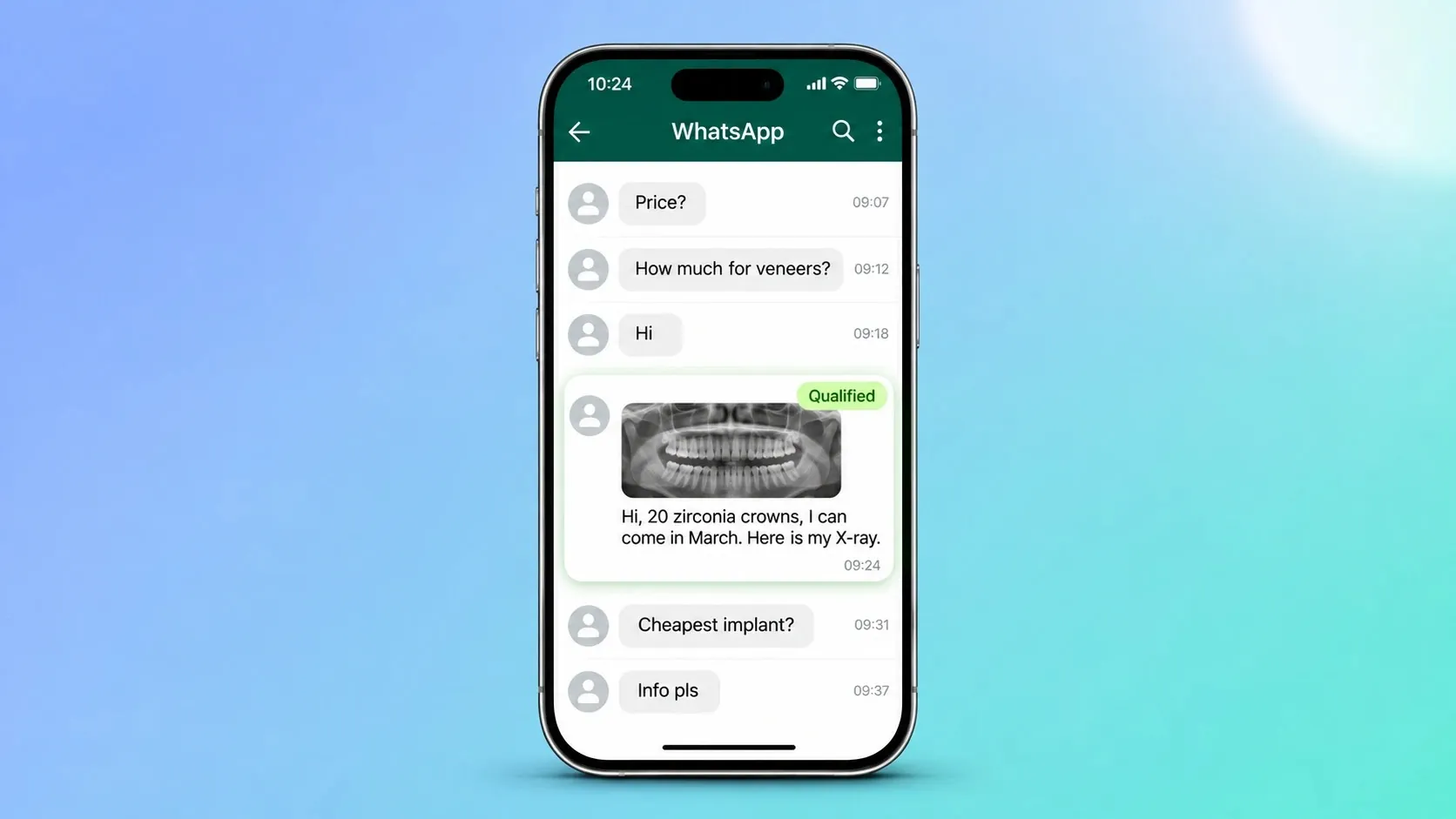
Then comes speed. A patient who writes in the evening should get a clear answer quickly, and a patient who goes quiet should hear from the clinic again on day 1, 3 and 7. Before the doctor joins, the patient should be qualified: budget, dates, photos and an X-ray.
Last, the patient flow should belong to the clinic. When the ad accounts, contacts and reviews stay with the clinic, the work keeps paying off after the first year.
Trust also continues after treatment. Asking a patient how they feel a few days after they return home protects the relationship and creates a natural moment to ask for a review.
What we learned in Antalya
In 2026 we started working with a partner clinic in Antalya. Before writing a single ad, we looked at how European patients search.
One finding surprised us. People search for "teeth in Turkey" rather than for implants or crowns, so the first ad and the first page have to answer a broad question before they talk about a specific treatment.
It is also why each market needs its own page. Patients from Poland, Czechia or Slovakia may search for the same thing, but they ask different questions and worry about different things.
That changed how the ads, the landing page and the budget were planned for each market.
Mistakes we often see in dental tourism ads
The most common mistake is competing on price alone, with words like "cheapest" or "cheap and fast". This attracts price hunters and can get ads rejected. Some ads also make savings claims that contradict each other, and others collect forms with free gifts, which brings many contacts and very few patients.
Many ads never show the doctor's name or face, and few mention a warranty or the implant brand, the two things patients ask about most. Others are written in the patient's language but lead to an English page.
Ads and patient pages that work start with trust and process instead: a video call with the doctor, a written price before the flight and contact after the patient returns home.
The patient journey your marketing has to cover
For a European patient, the decision can take weeks. Between the first search and the flight they may change their mind several times, so someone has to be there at every step.
- Search: a broad phrase such as "teeth in Turkey".
- Research: they compare a few clinic pages, read reviews and look at photos.
- First message: often in the evening or at the weekend, on WhatsApp.
- Assessment: X-ray and photos, then a video call with the doctor.
- Decision: they discuss the written price with family, then pay a deposit.
- Travel: flight, transfer and accommodation are planned.
- After treatment: check-ups, questions and, if they are happy, a review.
Most patients do not decide after the first message, so the follow-up is where many of them are won.
What your clinic needs before investing in ads
However good the marketing is, the experience in your clinic has to match the promise. You need a doctor with a few hours a week for video calls, an up-to-date written price list and before and after photos with patient consent.
You also need a clear plan for airport transfers and accommodation, and one person who answers questions after treatment. If these basics are missing, more ads usually bring more questions, not more patients.
What dental marketing in Turkey costs
The cost has two parts: the ad budget and the work around it, meaning the patient pages, the replies and the follow-up. That work can be done by the clinic's own team or by an agency. In both cases the patient should pay the clinic's own price directly to the clinic.
In our experience a patient enquiry from Google costs between €3 and €10, depending on the market and the treatment. Meta usually brings cheaper enquiries that need more qualification.
Paid ads bring patients quickly, while organic traffic builds over time. For the second part, see our dental SEO guide. For how the pieces of dental marketing fit together, see our homepage.
Frequently asked questions
What is the most effective dental marketing for patients from abroad?
A combination of ads in the patient's language, a patient page that answers real questions, a fast reply and a written price before the flight. Ads alone are rarely enough.
Which European markets are best for clinics in Turkey?
It depends on the clinic's treatments and prices. A good start is to compare markets by search demand, cost per click and competition, and begin where the numbers make sense.
How long does dental marketing take to work?
Most clinics see the first improvements in 4 to 6 weeks. The best results come after a few months.
Questions about this topic? Write to us.
ahoy@ouradent.com